
As part of Santos’ Annual Report materials, we have released our 2025 update on our climate strategy and Climate Transition Action Plan (CTAP) which details our progress and key climate commitments.
It takes into account feedback from shareholders and outlines how we are managing the risks and opportunities of the energy transition and describes the action we are taking towards our net-zero targets.
We have invested real dollars in real projects that are now leading to real emissions reduction.
Since our targets baseline year of 2019-20, we have achieved a 42 per cent reduction in our equity share Scope 1 and 2 emissions, exceeding our 2030 emissions reduction target.
We are confident that our climate strategy will enable Santos to generate shareholder value by supplying the energy needs of today while seeking to develop the low carbon fuels and carbon reduction solutions of tomorrow.
All information on this page should be read in conjunction with our Climate Strategy Update 2025 and our 2025 Annual Report.
Our purpose and vision
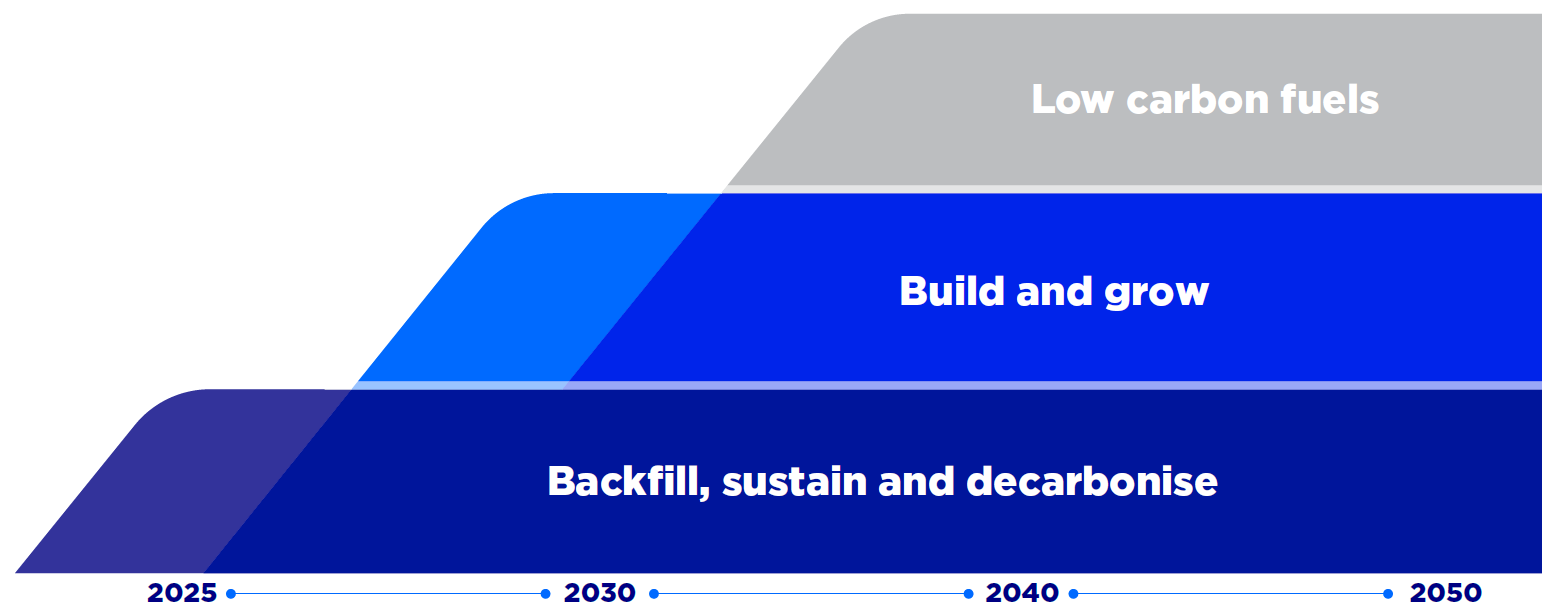
Santos’ purpose is to provide reliable and affordable energy to help create a better world for everyone. To deliver this purpose, Santos has a three-horizon strategy which underpins our decarbonisation pathway to net-zero Scope 1 emissions (equity share) by 2040 and net-zero Scope 2 emissions (equity share) by 2050.
It is focussed on backfilling, sustaining and decarbonising existing operations, continuing to build and grow through disciplined development of upstream resources, infrastructure and a commercial third-party carbon management business, and investing in the potential technologies needed to develop low carbon fuels of the future as markets evolve.
2025 Climate Transition Action Plan
Our CTAP outlines our current potential decarbonisation initiatives Santos is pursuing to achieve our Scope 1, Scope 2, commercial carbon storage growth and methane targets. It also provides a potential pathway to develop and deliver commercial carbon management services, lower carbon energy and low carbon fuels in the future.
Since 2023, we have invested over $690 million in CTAP activities. This real investment in real projects is now leading to real emissions reduction. Since 2019-20 (our target baseline year), we have achieved a 42 per cent reduction in our equity Scope 1 and 2 emissions, exceeding our 2030 emissions reduction target.
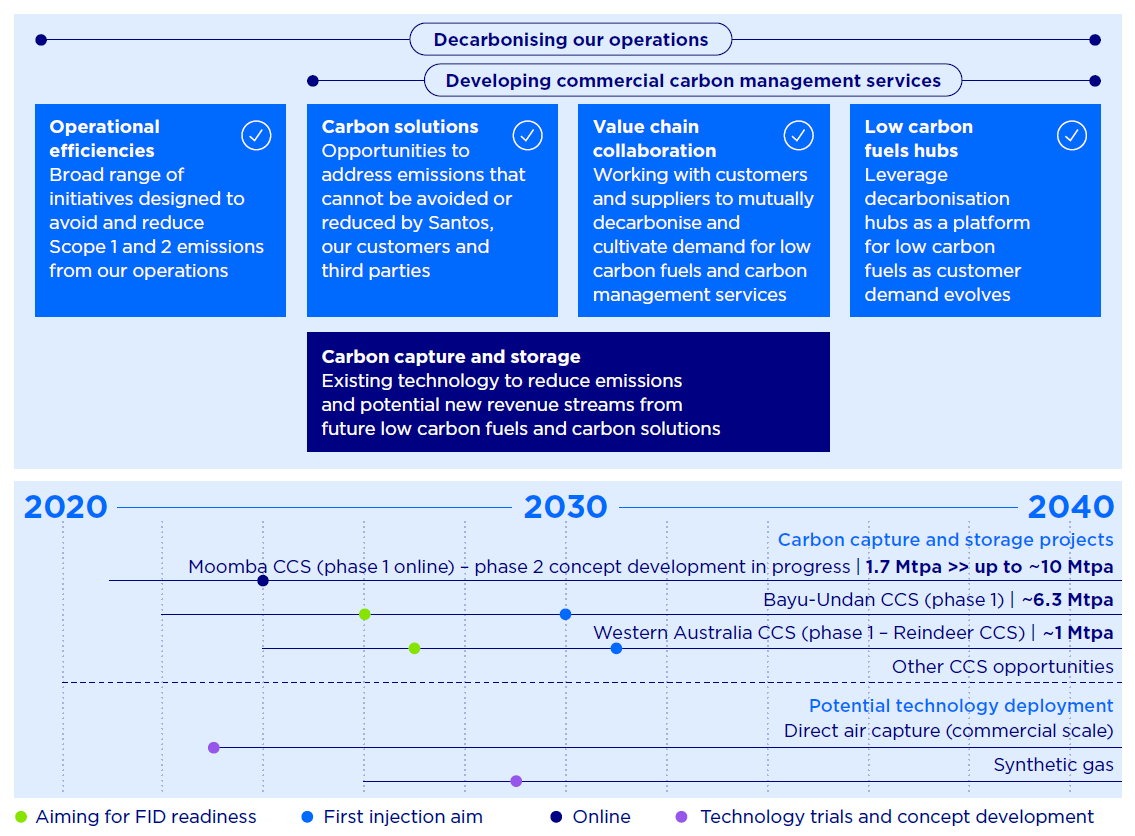
Refer to page 6 of the Climate Strategy Update 2025.
Our climate targets
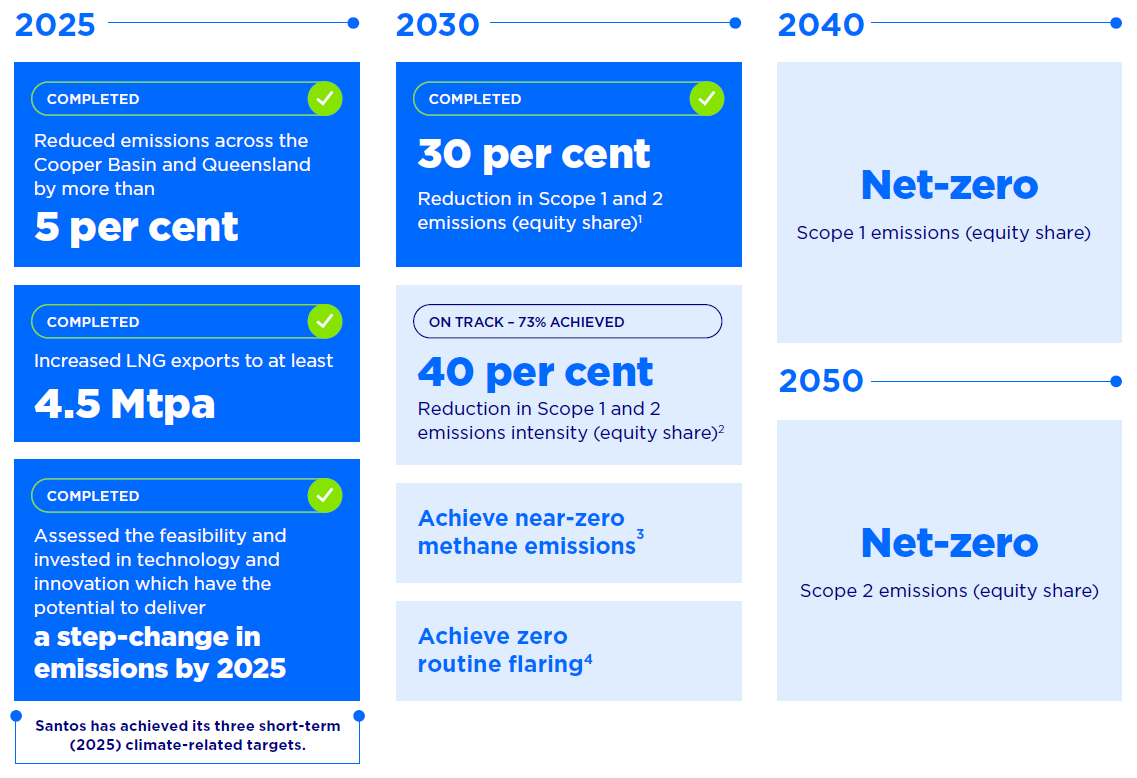
Refer to page 4 of the Climate Strategy Update 2025.
Building a commercial carbon storage business
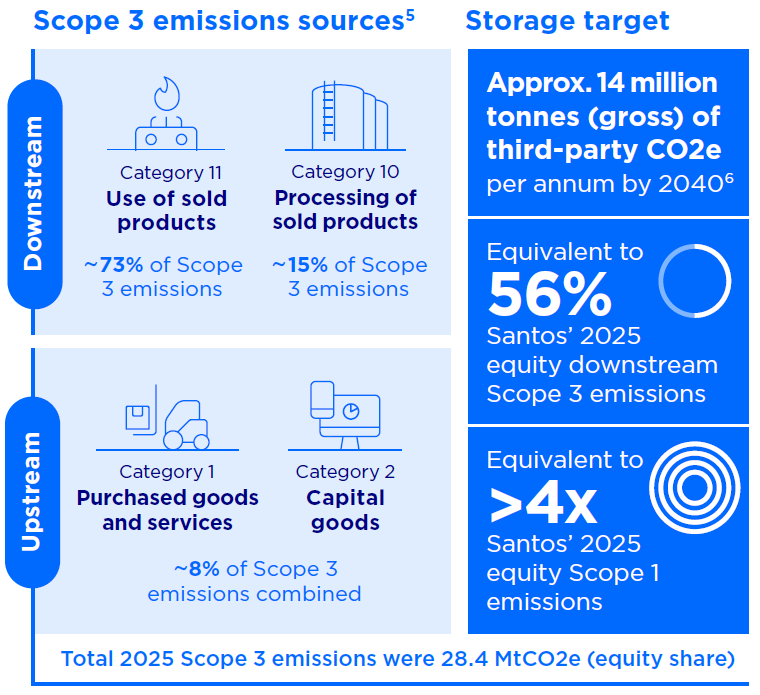
Santos aims to build and operate a commercial carbon storage business, safely and permanently storing approximately 14 million tonnes (gross) of third-party CO2e per annum by 2040.
While Santos can only influence third-party emissions, we acknowledge we can have a role. We are working with our customers and others to reduce them, consistent with our strategy to decarbonise our business and seek to develop low carbon fuels as markets evolve.
We aspire longer term to store more carbon than we emit (Scope 1, 2, and equivalent 3 emissions).
Refer to page 4 of the Climate Strategy Update 2025.
Approach to Paris Agreement goals
Santos is setting its targets and undertaking actions to contribute to UN Paris Agreement Goals as set out below.
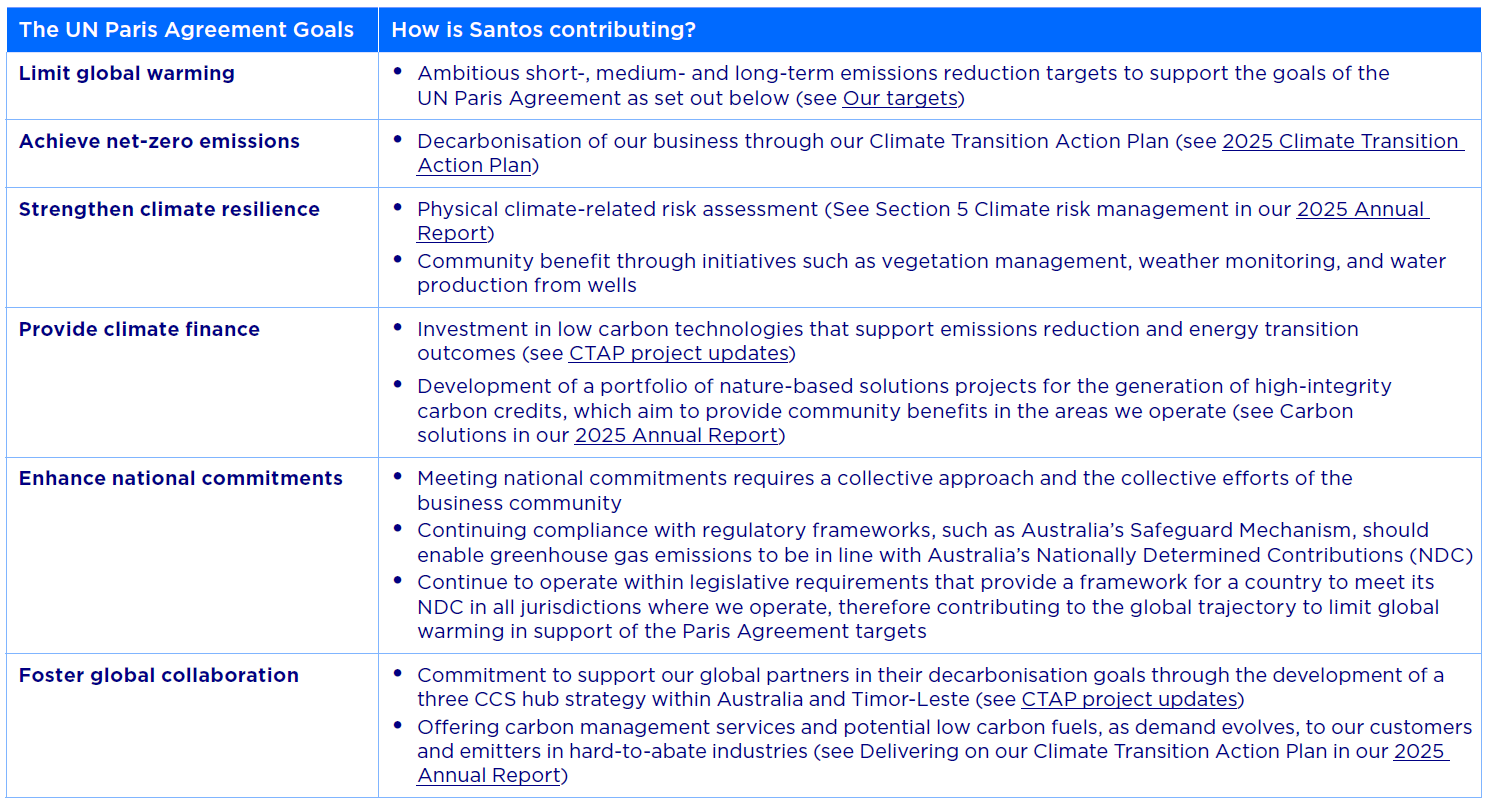
Refer to Climate Strategy Update 2025 and 2025 Annual Report references noted above for further information.
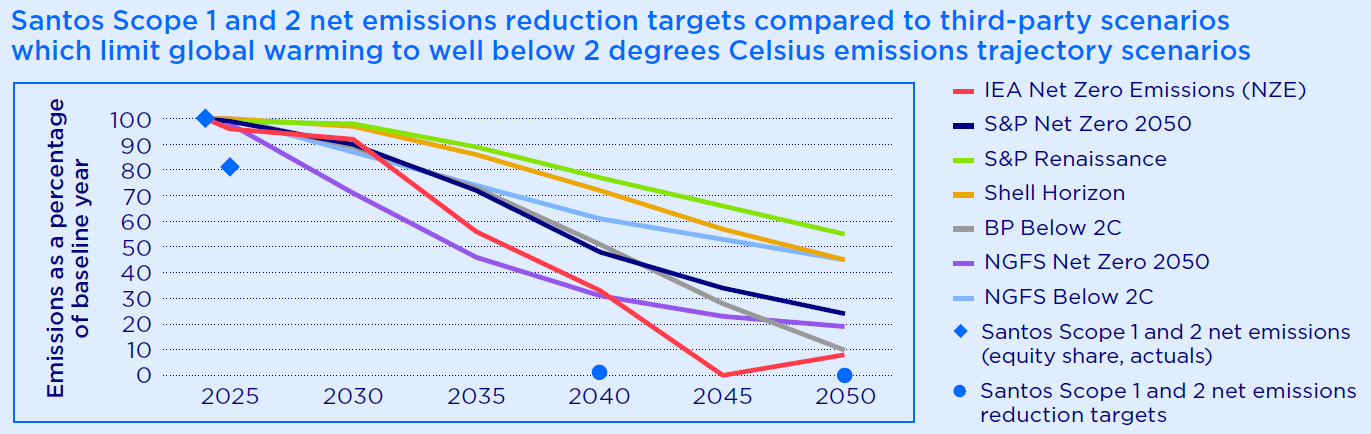
Refer to page 11 of the Climate Strategy Update 2025.
Santos has undertaken analysis of how our Scope 1 and 2 net emissions targets generally compare against emissions trajectory scenarios that third parties have modelled which limit global warming to well below 2 degrees Celsius, a goal of the Paris Agreement. While Santos does not intend to represent any specific alignment of compatibility of its targets with these third-party below 2 degree scenarios (noting that those scenarios depict global gross emissions against a variety of energy sources), comparing our historic and targeted emissions[1] with such scenarios provides us with further general understanding of progress toward our climate goals.
The analysis used a range of below 2 degrees Celsius emissions scenarios developed by leading energy and climate institutions, including the IEA, S&P, Network for Greening the Financial System (NGFS), BP and Shell,[2] and sought to focus on emissions trajectories relevant to Santos’ operations. Our historic and targeted emissions were analysed using 2024 as the baseline year and were compared against these modelled scenarios.[3]
[1] Emissions reduction targets as per our climate targets on page 4 of the Climate Strategy Update 2025. The 2040 emissions reduction forecast represents the target of net-zero Scope 1 emissions plus a forecast of Scope 2 emissions through to the target of net-zero in 2050 based on portfolio forecast data accounting for electricity usage and forecast changes in grid intensity.
[2] Analysis also considered scenarios published by IPCC but were not included as it is not sufficiently current to reflect present-day conditions.
[3] While this chart aims to show a comparison of our historic and targeted emissions with third-party below 2 degree scenarios, Santos does not intend to represent any specific alignment or compatibility of its targets with those scenarios, noting that those scenarios depict global gross emissions against a variety of energy sources. The third-party emissions trajectories analysed are inclusive of all global emissions, including those which would be considered Santos Scope 3. Santos does not have control over Scope 3 emissions as they are the Scope 1 and 2 emissions of other entities, and as such we have not included our Scope 3 emissions in this analysis. In 2025, Scope 3 emissions (equity share) comprised approximately 88 per cent of our total Scope 1, 2 and 3 emissions (equity share). There remains uncertainty around below 2 degrees Celsius pathway scenarios as the science of climate change continues to evolve. Santos has utilised the most up-to-date third-party pathways available as at the date of the report to conduct our analysis, however we acknowledge that 1.5 degrees Celsius pathway scenarios are subject to many assumptions and uncertainties and emissions trajectories analysed were generally aligned as closely as possible to Santos’ operational context, including data interpolations as required where emissions trajectories did not align to the baseline year of 2024. However, limitations on external provider data availability and granularity may result in only partial comparability with Santos’ emissions reduction targets.
Approach to Scope 1 and 2 emissions
Santos employs a range of levers to decarbonise our operations in line with our emissions hierarchy of avoid, reduce and offset.
Our approach is to decarbonise our operations at the source of production, capture and store emissions which are not avoided or reduced and offset any residual emissions.
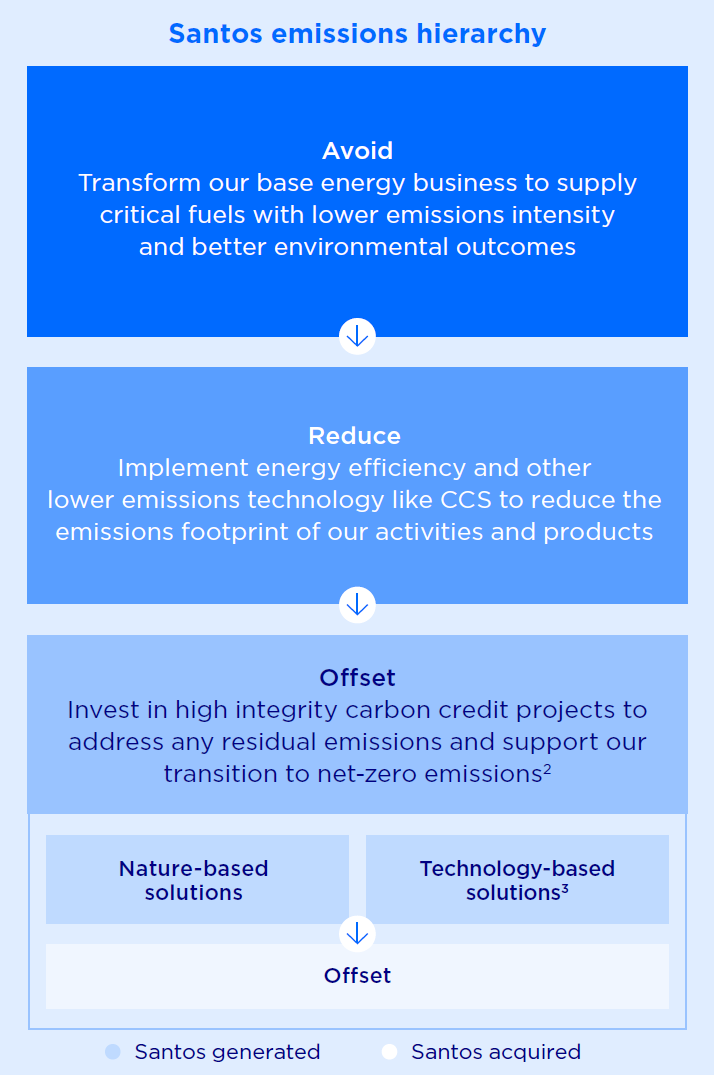
Our mitigation activities are structured to target each stage of production and our most material emissions sources.
This includes replacing or upgrading existing infrastructure to reduce emissions in existing operations, and minimising emissions from the outset of new projects.
We will continue to prioritise avoidance and reduction of our emissions as the key levers to decarbonise.
Refer to page 7 of the Climate Strategy Update 2025.
[2] For further information on high integrity carbon credits, including Santos’ Glossary, please refer to our 2025 Annual Report.
[3] Includes potential technology-based solutions, such as DAC.
Approach to Scope 3 emissions
Unlike Scope 1 and 2 emissions, Santos does not control Scope 3 emissions. We view our role as proactively supporting customers and suppliers to decarbonise primarily through offering carbon management services and low carbon fuels as demand evolves.
Santos’ carbon storage growth target underpins a long-term aspiration to store more carbon than we emit (Scope 1, 2 and equivalent 3).
We aim to build and operate a commercial carbon storage business, safely and permanently storing approximately 14 million tonnes (gross) of third-party CO2 per annum by 2040.[4]
2025 performance highlights
Santos also continues to identify opportunities to partner with our customers, suppliers and others in our value chain, including:
- Collaborating with an LNG vessel owner on sub-cooling technology delivering emission savings of ~5 ktCO2e in the first six months of 2025.
- Ongoing engagement with 170 suppliers to determine collaboration opportunities.
Refer to page 7 of the Climate Strategy Update 2025.
[4] This is a target not a forecast and is a growth target for gross storage from Santos operated carbon storage projects. The target is ambitious and subject to substantial engineering, finance, commercial and policy work to establish enabling frameworks with customers, governments, regulators and other stakeholders. The potential projects that would enable achieving the target remain at an early phase of planning and commercial and economic viability is still to be confirmed. Refer to ‘important notices’ at the back of the Climate Strategy Update for further information about these targets.
[5] The Scope 3 emissions sources depicted make up Santos’ material Scope 3 emissions categories. Other Scope 3 categories comprise 4 per cent of the total 2025 Scope 3 emissions (equity share) and are not considered material.
[6] Third-party CO2e could include emissions from third parties both within and outside of Santos’ value chain. Santos’ equivalent Scope 3 is a volume of emissions equivalent to our actual reported Scope 3 emissions.
Approach to methane emissions

In 2025, we continued to reduce methane emissions from our portfolio.
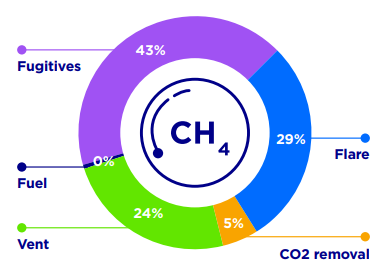
Methane emissions form a component of our Scope 1 and 2 emissions and equated to approximately 12 per cent of our total operated Scope 1 emissions in 2025.[1] Santos applies a specific focus and has developed an approach to detect, measure and mitigate them.
Our 2025 methane emissions remained stable compares to 2024, however embedded in this includes:
- a 50 per cent reduction in emissions from CO2 removal and venting activity
- a five per cent reduction in fugitive emissions.
OGMP update
A gap analysis carried out by a third-party against OGMP 2.0 requirements has identified that Santos’ current reporting practices are relatively mature in the context of global methane reporting. Based on this gap analysis, Santos emissions are generally aligned with OGMP 2.0 Level 3 reporting. While at this stage Santos has not committed to OGMP, in 2025 we have taken the following actions as part of our approach to methane:
- Engaged JV OGMP signatories on implementation, technology and potential trial support.
- Improved methane monitoring via enhanced leak detection and optimised surveillance.
- Supported JV partners with OGMP reporting for non-operated assets.
Effect of Moomba CCS project
Moomba CCS continues to deliver real emissions reduction for South Australia and Australia.
In 2025, Moomba CCS stored a total of 1.23 MtCO2e, and continues to significantly reduce the methane emissions of the Moomba plant. In 2025, Moomba CCS sequestered approximately 106 ktCO2e of methane.
[1] Measured on an operational control basis.
2025 Santos methane emissions
Refer to page 54 of the 2025 Annual Report.
Carbon capture and storage
With the world requiring more energy,[1] if we are serious about our climate targets, abating emissions from hydrocarbons has to be part of the decarbonisation solution.
In scenarios where warming is limited to 1.5 degrees Celsius, more than half of assumed gas demand by 2050 is abated through CCS.[1]
CCS is the process of capturing CO2 and storing it safely underground. It is considered to be a key pillar of decarbonisation by the International Energy Agency (IEA).[1]
CCS is one of the technologies with real potential to abate emissions at scale available today and there is no better example than our Moomba CCS project.
Moomba CCS phase 1
Santos’ Moomba gas plant’s infrastructure has been repurposed to extend the life of the asset, which has been producing gas for 50 years, to potentially also store carbon for the next 50 years.
Phase 1 of Santos’ Moomba CCS project successfully commenced injection in September 2024. It is currently one of the largest and lowest-cost projects globally.
In October 2025, Moomba CCS received its first Australian Carbon Credits Units (ACCUs). The issuance of 614,133 ACCUs is the single largest issuance by the Clean Energy Regulator. A further 293,739 ACCUs were issued prior to the end of 2025.
Refer to page 8 of the Climate Strategy Update 2025.
[1] IEA 2025, World Energy Outlook 2025.
Low carbon fuels
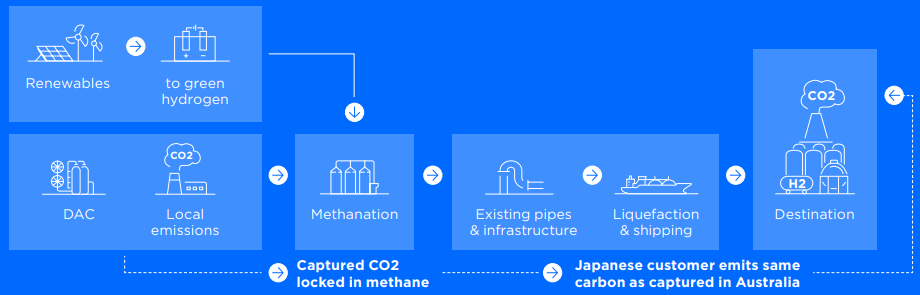
Santos is exploring concepts and technologies to support the potential delivery of low carbon fuels. It is a customer-led opportunity to supply products that reduce both Santos’ and our customer’s emissions. Santos has completed early engineering studies on a synthetic gas facility in the Cooper Basin with a number of partners looking at commerciality of producing low carbon synthetic gas from hydrogen and captured carbon dioxide for export to Japan.
Santos is also evaluating acreage in the Cooper Basin for a geothermal pilot project. Geothermal power in the Cooper Basin has the potential to support further decarbonisation of Santos’ assets and enable future low carbon fuels productions.
Electrification and renewables integration
Santos continues to electrify its operations, where it passes commercial hurdle rates, and integrate the use of renewable energy as an alternative to traditional gas-fired or diesel fuel sources.
We have completed, or are progressing, a number of projects that will introduce renewable energy and battery power into our operations. These include:
- The Moomba Electrification Project, a three-phase initiative aimed at simplifying operations and reducing emissions from our Cooper Basin operations
- The GLNG Upstream Electrical Convert project, converting two of the Fairview Hub Four compressors from gas drive to electric drive
- Installation of solar and battery power at our Cook and Limestone Creek camps
- Deploying modular solar-and-battery systems for CSG exploration and appraisal wells, replacing diesel generators
Moomba Central Optimisation
In March 2026, Santos announced that it had taken a final investment decision (FID) on the Moomba Central Optimisation project, in South Australia’s Cooper Basin. Santos will invest $357 million (net Santos) in the project which is planned to be delivered over three years.
The MCO project will replace seven ageing gas-driven compressor stations with one electric-driven compressor station that will debottleneck upstream infrastructure and unlock future production growth from the Cooper Basin Central Fields in South Australia. At the Moomba Gas Plant, new inlet compression and additional power generation capacity will be installed to receive gas and power the upstream satellite.
When announcing FID, Santos Managing Director and CEO, Kevin Gallagher said, “By replacing ageing infrastructure with modern, electric-driven technology, we will reduce operating costs, improve reliability and lower emissions.
“Importantly, the project is estimated to reduce Santos Scope 1 emissions by over 40,000 tonnes of CO₂ equivalent per year, supporting our Scope 1 emissions reduction targets.”
Additional information
In 2025, Santos actively engaged in 110 ESG-focussed meetings seeking feedback from investors and investor groups. Moving forward, we are committed to continuing this transparent dialogue as we pursue our climate targets and aspirations.
These discussions have been pivotal in aligning our plans with investor expectations and identifying key areas for growth and improvement.
Santos’ commitment to ongoing, proactive engagement with shareholders was reflected in the strong support for our 2025 ‘Say on Climate’ resolution. Through sustained dialogue and responsiveness to investor feedback, more than 85 per cent of voted shares endorsed our plan.
This table here highlights the main themes raised by investors and actions we have taken, or our rationale, in response to feedback.
Santos’ Scope 3 emissions are the indirect emissions generated through our value chain. To better understand and quantify our Scope 3 emissions, we have worked to develop insights on the emissions generated by our customers and suppliers and their efforts to reduce these emissions. To progressively reduce our Scope 3 emissions, it is critical that we investigate joint emissions reduction opportunities and collaborate on those economically viable for both parties.
Santos continues to work with our LNG and domestic gas customers to reduce the emissions generated from downstream use of these products. Following on from the detailed work undertaken in 2024, we continued to engage with customers in relation to their use of our products. This approach previously provided an understanding of how our products contribute to reaching customer emissions targets, and how customer emissions reduction pathways could influence Santos’ Scope 3 emissions. Our engagement in 2025 confirmed there was no change in the processing or use of our products.
Santos’ procurement specialists maintain effective working relationships with our suppliers across all aspects of Santos’ business. Our specialists regularly discuss opportunities with suppliers that, through the provision of certain goods and services and emissions reduction initiatives, have the potential to reduce emissions within our supply chain.
Santos has performed an analysis of our exposure, impacts and potential mitigating responses to both transition and physical climate-related risks and opportunities. We test our strategy and business model to determine our resilience to a range of potential climate future states. Santos evaluates the resilience of our portfolio with reference to both quantitative and qualitative factors.
Santos’ portfolio has been tested and shows resilience in an energy transition that limits global temperature increase to 1.5 degrees Celsius.
You can read more on page 85 of the 2025 Annual Report.