
Our reporting suite
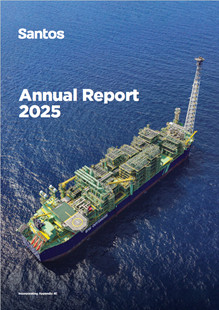
Our primary disclosure document containing our operational and financial review, sustainability and climate performance, remuneration report, financial statements and key governance disclosures.
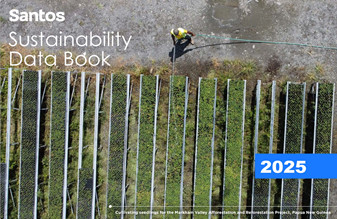
Provides key data for sustainability metrics, trends and additional sustainability disclosures.
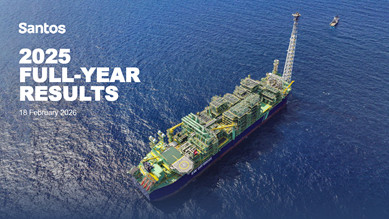
Provides performance highlights and supplementary information on Santos’ strategic and financial performance for the convenience of analysis and institutional investors.
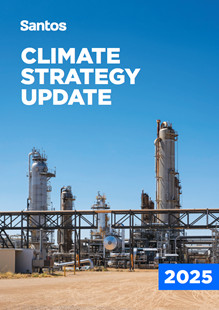
Addresses our key strategic climate policy commitments and provides an update on our Climate Transition Action Plan (CTAP).
This sustainability information should be read in conjunction with our 2025 Annual Report.
To view our GRI Index, click here.
Our approach to sustainability
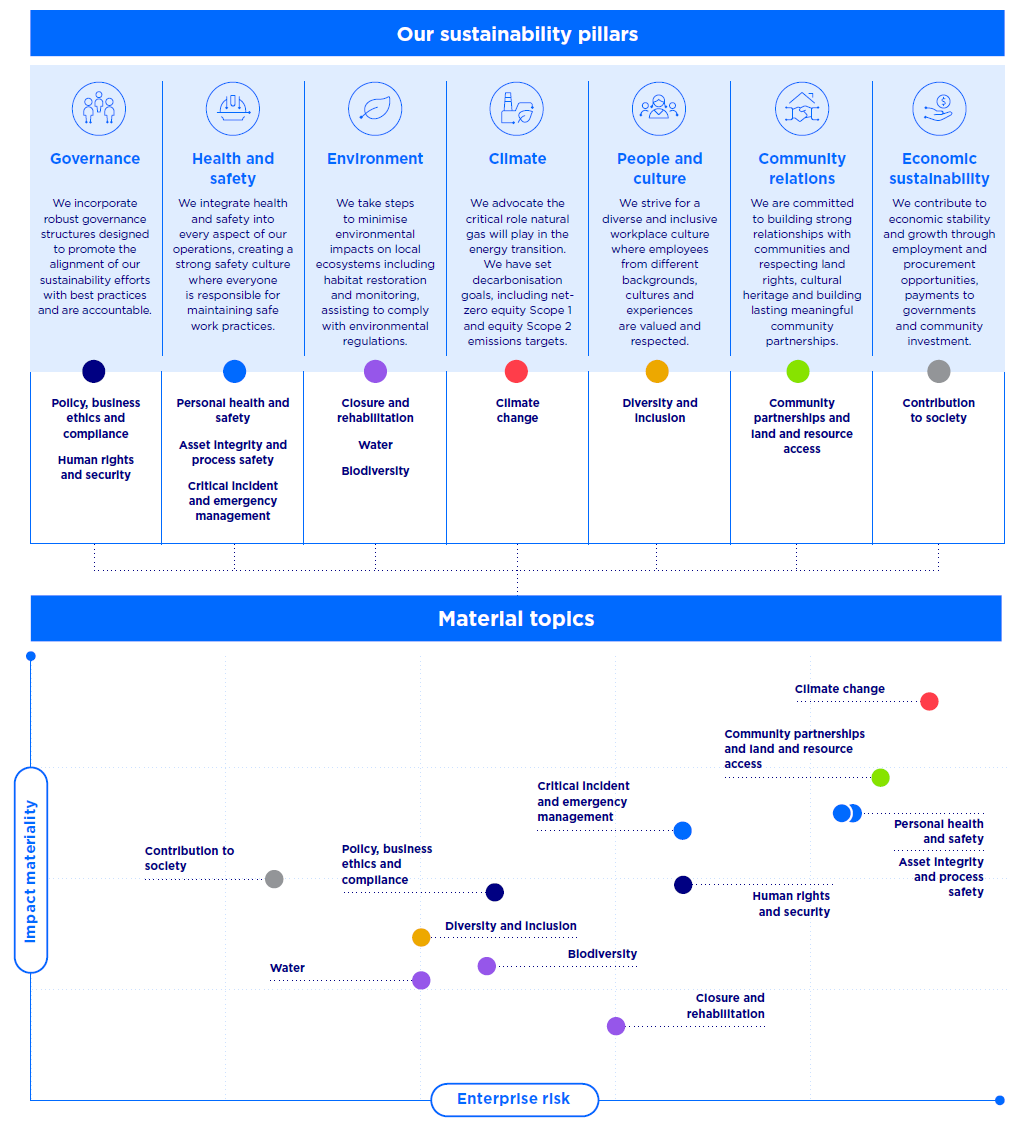
Our seven sustainability pillars support the implementation of our strategy. We focus on managing risks and opportunities to drive long-term shareholder value while considering broader environmental and social impacts.
Our sustainability pillars
At Santos, sustainability is about building a better future and creating long-term value for our stakeholders. We seek to balance the needs of today, supplying reliable and affordable energy, with the need to transition to a lower carbon future.
We have a framework based on seven sustainability pillars which underpin the delivery of our strategy and are essential to Santos’ efforts to consider the environmental and social impacts of our activities. The pillars provide structure for our materiality process, risks and opportunities and setting sustainability objectives and goals which helps guide our strategy, monitor performance and manage our material issues.
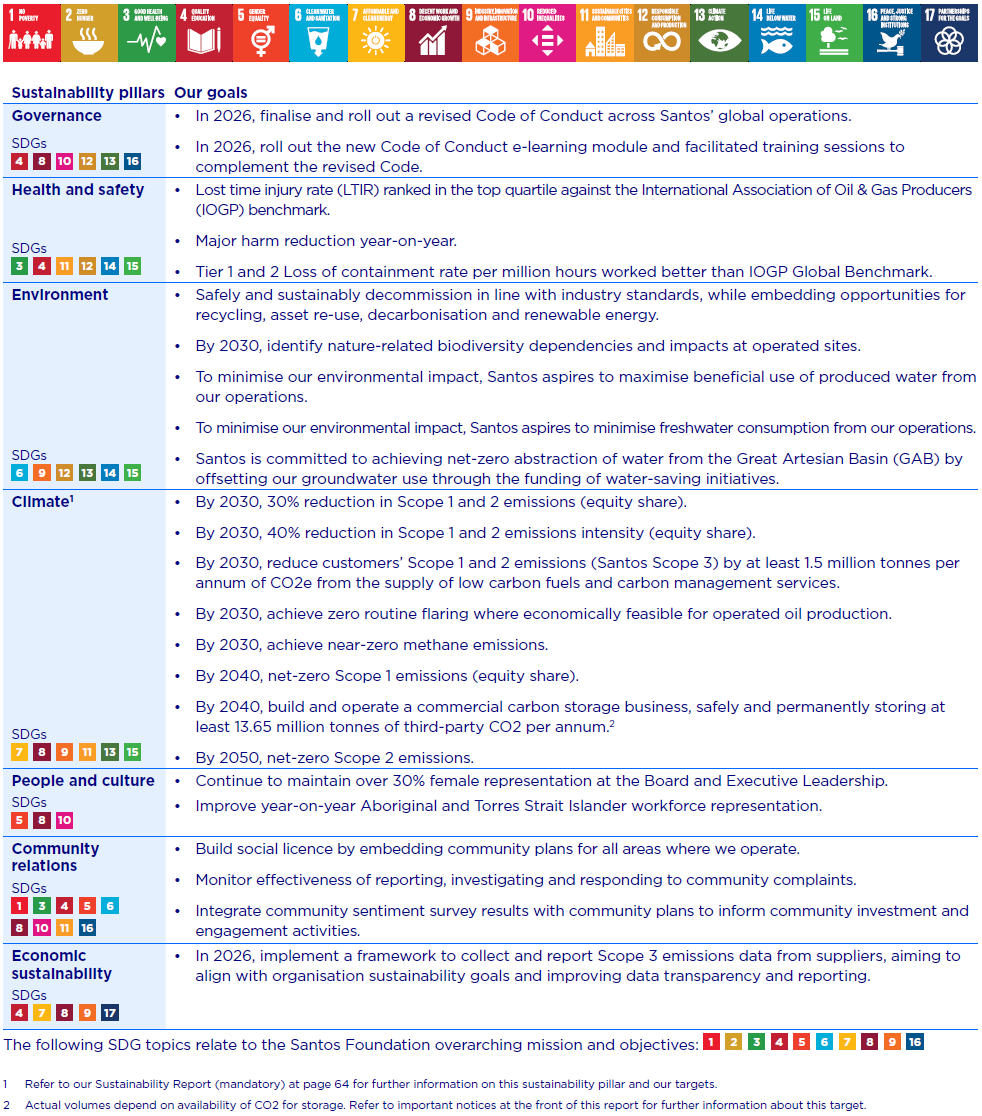
Our pillars are outlined below. We have set Company goals and linked them to global goals and objectives.
Our goals
We align our sustainability framework with the most relevant United Nations Sustainable Development Goals (UNSDGs), focussing on the areas where we can make the greatest impact and contribute to global progress.
Our sustainability performance in external benchmarks
Santos actively engages with ESG ratings as part of our ongoing commitment to improving our reporting and disclosures. Our 2025 performance included industry-leading results in the S&P Corporate Sustainability Assessment and MSCI’s ESG Ratings.
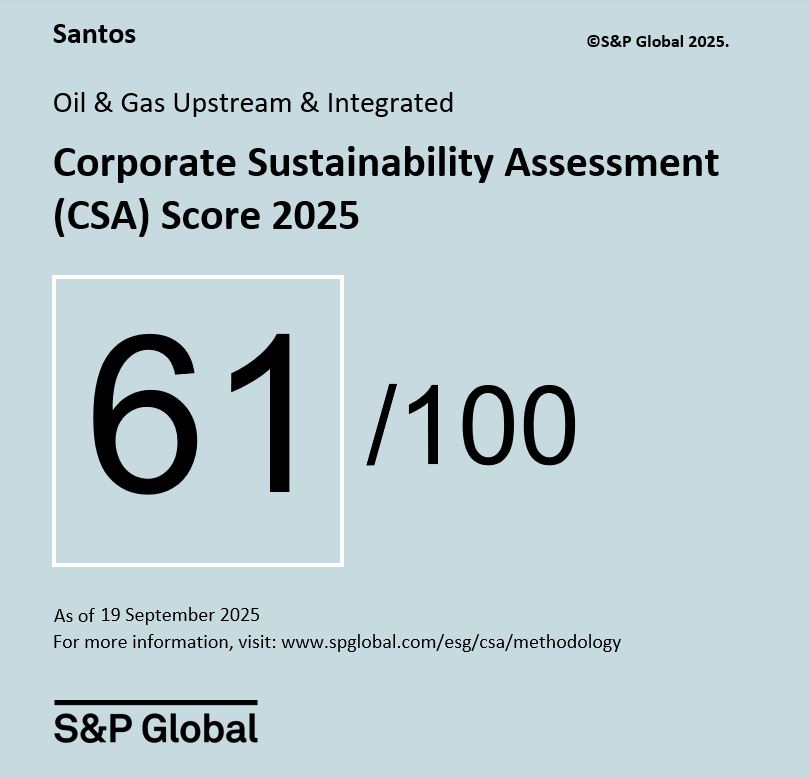
S&P Corporate Sustainability Assessment (CSA)
Top eight per cent among our peers [1].
Santos has improved our S&P CSA score in 2025 from 55 to 61 with very high data availability.
[1] Source: https://www.spglobal.com/esg/scores/results?cid=4157467
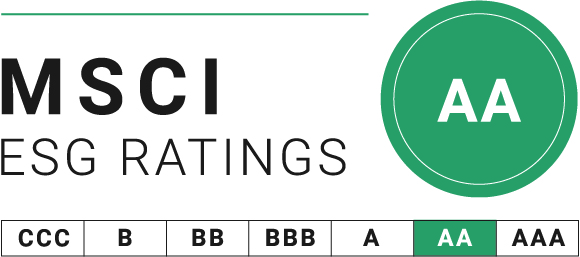
MSCI ESG ratings
Top quartile among our peers.
As of 2025, Santos received an MSCI ESG Rating of AA. We are classified as a ‘leader’ in managing the most significant sustainability risks and opportunities.
The use by Santos of any MSCI esg research llc or its affiliates (“MSCI”) data, and the use of msci logos, trademarks, service marks or index names herein, do not constitute a sponsorship, endorsement, recommendation, or promotion of Santos by MSCI. MSCI services and data are the property of msci or its information providers, and are provided ‘as-is’ and without warranty. MSCI names and logos are trademarks or service marks of MSCI.

CDP
Santos also discloses to other third-party rating agencies, including CDP.
Sustainability governance
The Board views sustainability as a material strategic area for Santos. It oversees the safe and sustainable operations of the Company in accordance with our values, within a Risk Management Framework that respects all stakeholder interests.
Effective corporate governance is critical to the long-term success and future of Santos. The Board and all levels of management are committed to maintaining and enhancing a strong corporate governance framework.
The Board has ultimate responsibility for the approval and oversight of strategy, including our approach to sustainability. The Charters for the Board and each Committee formally outline the responsibilities of each body in respect of sustainability, including the monitoring and review of risks.
The Board’s oversight of sustainability is supported by board committees, including the Safety and Sustainability Committee which meets four times per year (and as determined by the Chair of the Committee). The Committees’ cross memberships support sound communication of sustainability-related matters across the various committees.
The CEO reports to the Board and is responsible for delivering the strategy and goals approved by the Board. These include accountability for outcomes of sustainability-related goals approved by the Board. The CEO is supported by the Executive Leadership Team. The CEO and Executive Leadership are in turn supported by their teams.
To help effective cross-functional communication on issues related to sustainability and climate, Santos’ governance processes include meetings across a range of business groups. This includes meetings of the Executive Leadership Team to require conformance with the Santos Management System (SMS) and to track delivery against plans and goals as well as the effectiveness of controls and processes pertaining to sustainability-related activities.
The Board also approves the Santos Code of Conduct, which is applicable to any person who performs work, or provides services, in any capacity for, or on behalf of, Santos, including full-time and part-time employees, officers and directors; contractors, agents, consultants and subcontractors; and apprentices, trainees, secondees, students gaining work experience, and volunteers (“Santos Workers”).
Reports, findings and recommendations from audits conducted by the risk and internal audit function in respect of ethical standards are reviewed by the Audit and Risk Committee. The Audit and Risk Committee also reviews Santos’ mandatory ethical standards and expectations, and our compliance with them, on a regular basis, including through the review of reports from Management on any material breaches of the Company’s Code of Conduct and Anti-Corruption and Sanctions Procedure or material incidents involving fraud. The Committee also reviews the independence and effectiveness of the Whistleblower and Reporting Misconduct system including by receiving, at least on a quarterly basis, an overview of Whistleblower and Reporting Misconduct complaints.
Santos reviews the effectiveness of the Human Rights and Modern Slavery Policy. This monitoring process is undertaken through and published in the company’s annual Modern Slavery Statement. Focus areas which are reported against include governance and due diligence, risk management, procurement and supply chain, engagement, training and education, and grievances and reporting.
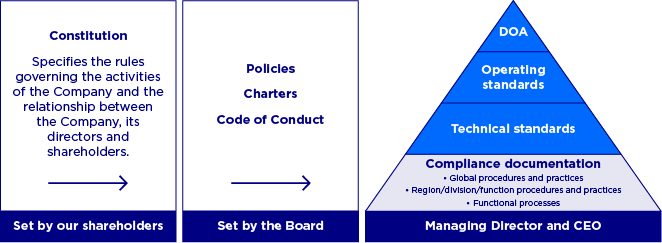
The SMS applies to all of Santos’ people and establishes the requirements for how Santos does business across our assets and functional support teams. It is designed to protect people, the communities where Santos operates, and the safe and effective operation and conduct of activities. The SMS includes:
- Delegation of Authority (DOA)
- Operating Standards explaining the minimum standards for ‘what’ the company must achieve
- Technical Standards that detail technical requirements or specifications that must be achieved in a consistent manner in support of the relevant operating standard.
The regional businesses and functions are responsible for establishing operating procedures, practices and processes that achieve the requirements of all standards. Where there is business benefit in doing so, global procedures and practices are put in place to deliver a consistent approach to internal conformance with the standards.
Reporting processes and practices are informed by and reflect our commitment to current industry applicable standards, guidance and frameworks, including:
- Global Reporting Initiative – GRI Standards, GRI 11 Oil and Gas Sector 2021 and GRI 3 Material Topics 2021 (refer to the GRI Index at here).
- Sustainability Accounting Standards Board, Oil and Gas Sector.
- Ipieca, the global oil and gas association for advancing environmental and social performance across the energy transition.
- UNSDGs 17 Goals and key objectives.
Our engagement with peers and industry associations, including the Ipieca Sustainability reporting guidance, give us contemporary guidance and common references. Our Sustainability Report also undergoes limited external assurance of our qualitative and quantitative statements. Refer to the assurance statement within the 2025 Annual Report for more information.
Investor feedback and our response
Engagement with our stakeholders is a priority for Santos. Following the release of the 2024 Annual Report, Santos sought feedback from investors and investor groups on our sustainability strategy and disclosures. Refer to the table on page 21 which outlines the key themes raised by shareholders and the steps taken to address, or otherwise explain our rationale, in response to this feedback.
Sustainability advocacy
We are a member of a large number of organisations, ranging from community bodies, chambers and business councils relevant to the communities and regions we operate in, as well as industry-related representative bodies known as ‘industry associations’.
Santos is a member of these organisations so that we can:
- gain an understanding of communities, regions and economies where we operate
- understand how we can contribute positively and effectively with stakeholders
- enhance technical knowledge, share learnings and develop standards within industry
- engage in policy development.
Our memberships allow us a forum to listen, debate, seek alignment and promote the key interests of communities and industry organisations. In addition to our policy positions, this advocacy is also guided by our support for the Paris Agreement where it acknowledges the need to balance emissions reduction with “the imperatives of a just transition of the workforce and the creation of decent work and quality jobs in accordance with nationally defined development priorities.”[1]
[1] United Nations Framework Convention on Climate Change. Paris Agreement: unfccc.int/process-and-meetings/the-paris-agreement/.
Santos engages with all levels of government in relation to our projects, operations, maintaining energy supply and reducing our carbon footprint. In Australia, this includes engagement in business forums and events where Santos pays for membership and/or attendance.
Santos believes it is important for us to engage in the discussion about the world’s energy future and the role we can play through our natural gas portfolio and our emerging low carbon fuels business.
We manage fundraising requests from Australian political parties under rules set out in an operating standard and we:
- do not make cash donations to political parties or candidates
- declare payments made for attending political events and memberships of political party business forums in accordance with applicable legislation.
In Papua New Guinea and Alaska, we do not engage in fundraising for political parties through the corporate treasury. Being involved in political party business programs in a bipartisan manner is an appropriate and important way for the business community and Santos to contribute transparently to the political process, and to help ensure the stability of democratic systems. This helps foster stable policy, regulation and taxation for business, which in turn generates investment, jobs and greater prosperity for the communities we operate in. These programs have transparent membership fees and services.
Santos is a member of the following Australian national political party business forums:
- Federal Labor Business Forum (Federal ALP)
- Australian Business Network (Federal Liberal Party)
- National Policy Forum (Federal National Party).
From time-to-time, specific events such as Budget or Budget-reply events or policy launch events are also held. Individual members of parliament or candidates also host business events featuring guest speakers who are generally ministers or shadow ministers. Participation in these events often requires payment of an attendance fee not covered by the fees paid for membership of the business forums. Attendance and representation of Santos at a political event is regulated by the SMS and CEO approval is required in accordance with the Delegation of Authority.
Given there is no public funding of Commonwealth election campaigns, there is an expectation by the major political parties that the corporate sector will engage through the above transparent mechanism. The involvement of a wide range of companies in this process helps to ensure that funding of the democratic process is received from multiple sources and wide-ranging policy positions and interest, so that no single interest unduly influences the political process.
Santos is not a member of state-based political party business forums and considers individual event requests on a case-by-case basis where there is a clear business reason. Federal, State and Territory Electoral Commissions in Australia publish reported payments through transparency registers and electronic disclosure systems.
Santos’ submitted returns can be found on the Australian Electoral Commission’s Transparency Register here.
Santos recognises the scientific consensus of climate change assessed by the IPCC. We support the objective of the Paris Agreement to limit global temperature rise to less than 2 degrees Celsius and pursue efforts to limit the temperature increase to 1.5 degrees Celsius.
Through direct engagement with policy makers and indirect engagement through our industry association memberships, Santos advocates for environmentally, socially and economically effective and responsible energy and carbon policies that are aligned with our Climate Policy.
Santos actively works with, and provides input to, governments and stakeholders in the design of climate regulation. We do this in pursuit of decarbonisation goals, striving for a policy and regulatory framework that supports lowest-cost abatement and innovation and investment in low emissions technologies, while continuing to provide access to reliable and affordable energy in Australia and Asia.
In 2025, this included direct engagement with, and/or submissions made, to government agencies on the following topics:
- implementation of the Net Zero Fund
- Sea Dumping Carbon Capture and Sequestration
- Climate Change Authority Issues Paper: Enhancing the ACCU Scheme to support Australia’s 2035 emissions reduction target
- reform of the Environment Protection and Biodiversity Conservation Act 1999.
These submissions were assessed against our Climate Policy for consistency with the Company’s public positions.
Santos similarly assesses the climate policy positions of the industry associations of which we are a member. Where an association is neutral or unaligned to Santos’ climate policies, the Company will make its views known to the association by working proactively to influence alignment. This includes promoting the goals of the Paris Agreement, recognition of the scientific consensus of climate change and support for net-zero emissions by 2050 or earlier.
In 2025, out of the 11 associations assessed, we found that eight were aligned with Santos’ climate policy positions and three were neutral.
Building on this, we will continue working with the Alaska Oil and Gas Association, and Resource Development Council of Alaska to align their climate policies to our own. The remaining neutral body, the Australian Resources and Energy Employer Association, is appropriate to be classified accordingly given the focus of its activities and advocacy is not climate or environmental matters.
We integrate human rights advocacy into our business practices by focusing on Indigenous rights and community engagement, fair labour practices, responsible supply chain management and external security arrangements. Our approach reflects a broad commitment to ethical corporate behaviour and sustainable development.
Our commitment to sustainability and corporate responsibility includes integrating human rights considerations across our operations. We recognise potential human rights risks associated with our environmental footprint, interactions with Indigenous communities, labour practices and broader social issues throughout our activities.
Human rights commitment and policy
Our company has implemented a Human Rights and Modern Slavery Policy. Santos is committed to supporting and respecting the protection of internationally recognised human rights as set out in the United Nations International Bill of Human Rights and works to align to the UN Guiding Principles on Business and Human Rights and the Voluntary Principles for Security and Human Rights in our practices and procedures.
Respect for Indigenous rights
We operate in regions that overlap with traditional lands of Indigenous communities, particularly in Australia, Alaska and Papua New Guinea. The Company has a specific focus on respecting the rights of these communities by:
- consulting with Indigenous peoples on land use
- acknowledging their connection to the land
- identifying suitable commercial opportunities to partner with Indigenous businesses and employment and upskilling of local Indigenous people.
We collaborate with local Indigenous groups so that our projects benefit these communities economically and socially, while also respecting cultural heritage and environmental stewardship.
Supply chain management
We are committed to fostering a supply chain that respects human rights. Key due diligence measures encompass supplier assessments, deep-dives and advanced counterparty screening through Compliance Catalyst. These efforts are overseen by our internal Modern Slavery Working Group, which monitors processes, identifies additional risks and opportunities.
Workplace rights and safety
Santos prioritises the rights of its workers by:
- fostering diversity and inclusion
- upholding fair labour practices, including no tolerance for discrimination, harassment and exploitation
- focusing on potential human rights impacts from security arrangements – both public and privately provided.
Our operations are aligned with Occupational Health and Safety (OHS) standards and labour laws across the regions in which we operate, reinforcing our commitment to a safe and equitable workplace as part of our human rights advocacy.
Transparency and accountability
We engage in transparent reporting on human rights impacts through our Sustainability Reports and Modern Slavery Statements. The Company tracks our progress and performance on human rights issues and shares this information publicly. This includes efforts to address risks of modern slavery within our operations and supply chains.
Grievance mechanisms
Santos maintains internal processes and an external grievance mechanism for individuals who work for or with us, including the community at large, to facilitate reporting of potential breaches of our Code of Conduct, including in relation to human rights concerns. Reporting can be made anonymously.
Material Topics
Materiality assessment process
We undertook our materiality process in accordance with the Global Reporting Initiative (GRI) Standard on material topics.
Our process involved four steps:
- Understanding Santos context
- Identifying actual and potential impacts
- Assessing the significance of impacts
- Prioritising most significant impacts for reporting
We reviewed our impacts with both internal and external stakeholders according to the GRI standard methodology. This review helps to ensure that our material topics stay relevant, evolve and represent our most significant impacts and those of greatest concern to our stakeholders.
Read more on the materiality process in the 2025 Annual Report.
Material topics
Our material topics reflect a comprehensive review of the impacts across our sustainability pillars. We focus on reporting our most material topics each year with other important topics covered on our website.
| Materiality | Channels of communication on topics for stakeholders |
|---|---|
| Material topics | Material topics are covered in the Annual Report. Data is in the data book. |
| Important topics Air Waste Employment practices | Important topics not deemed to be material in 2025 but are managed topics. Information for stakeholders is located on the website covering approach, process and due diligence and performance. Data is in the data book. |
Our Value Chain
Santos has three business sectors that make up our diversified portfolio:
- Liquefied natural gas (LNG)
- Integrated oil and gas
- Midstream and Energy Solutions.
We understand our value chain and focus on creating value with purpose. We aim to provide the critical fuels the world needs. The illustration on pages 10-11 in the 2025 Annual Report provides a non-exhaustive view of our value chain, outlining current and potential activities and how we create and deliver value for our shareholders, customers and communities.
Read more about how we create and deliver value in the 2025 Annual Report.
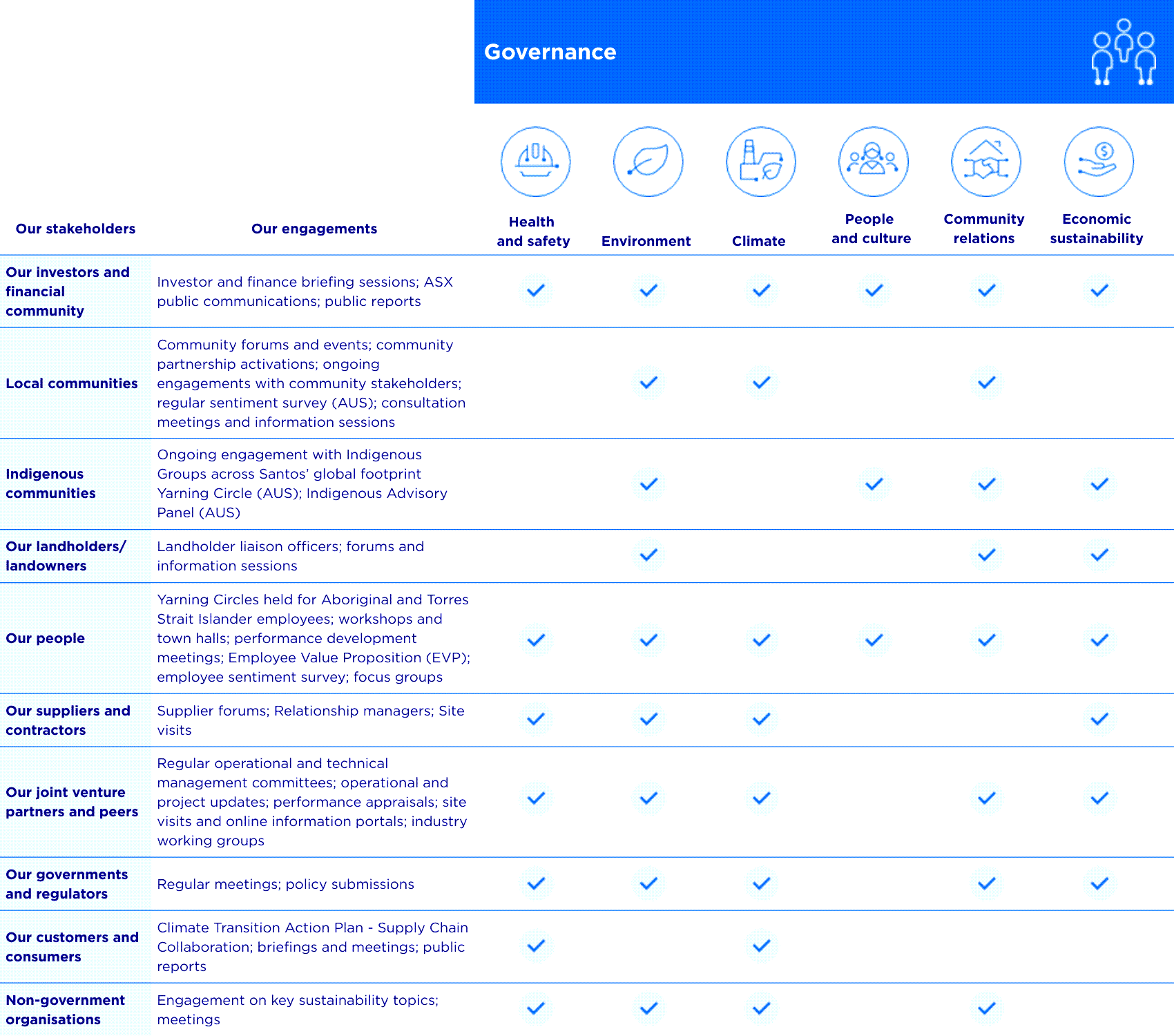
Stakeholders’ materials topic alignment
Regular engagement with our stakeholders enables valuable feedback on managing our material topics. We engaged with 10 diverse stakeholder groups who participated in interviews and an online survey to help understand, validate and prioritise our material topics. The table below summarises our stakeholders’ concerns and our responses.
Quick links
2024 Annual Report (incorporating the Sustainability and Climate Reports)
Sustainability and Climate Report 2023
2023 Sustainability Report
2023 Climate Change Report
2022 Sustainability Report
2022 Climate Change Report
2021 Sustainability Report
2021 Climate Change Report
2020 Sustainability Performance Report
2020 Climate Change Report
2019 Climate Change Report
2018 Climate Change Report